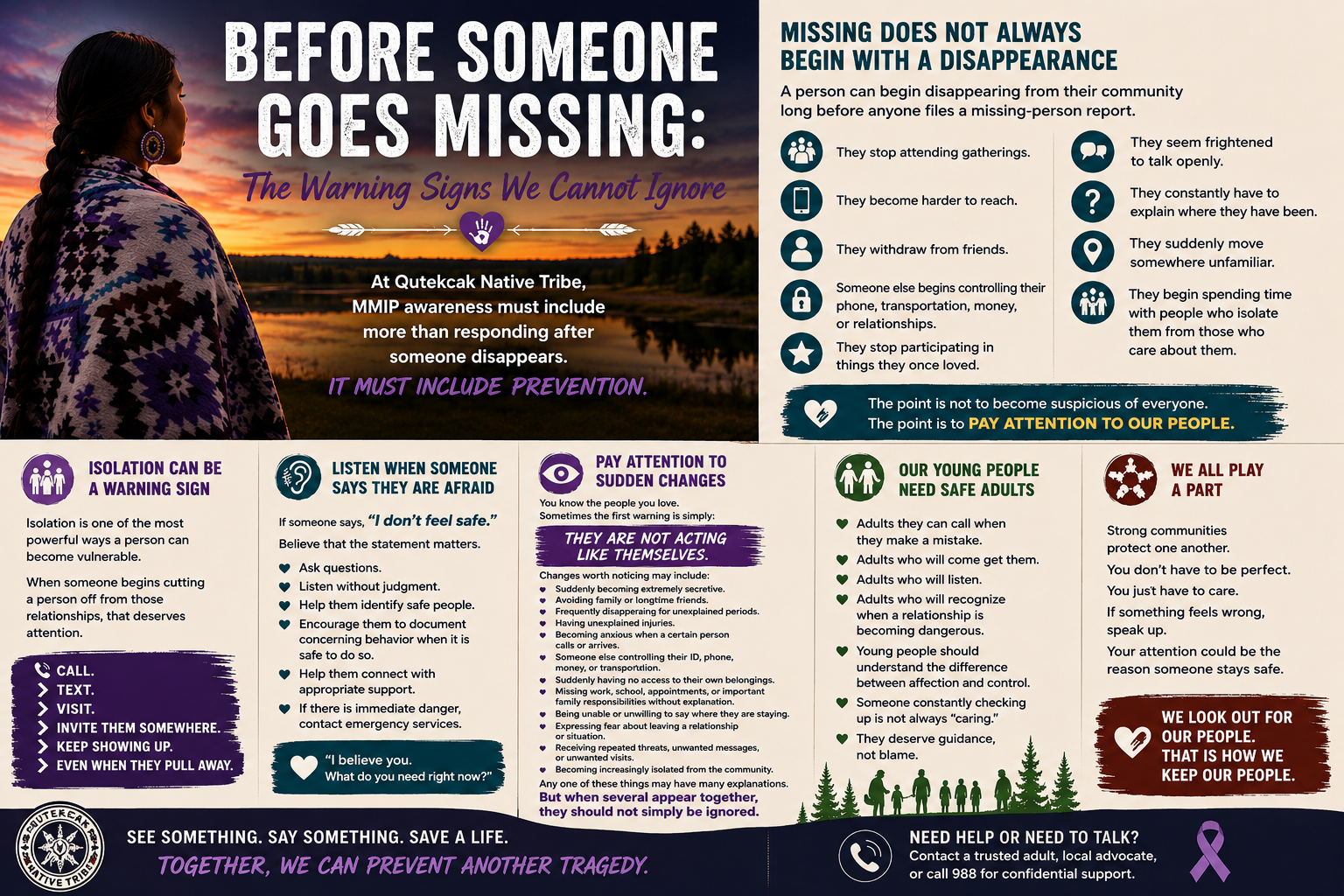

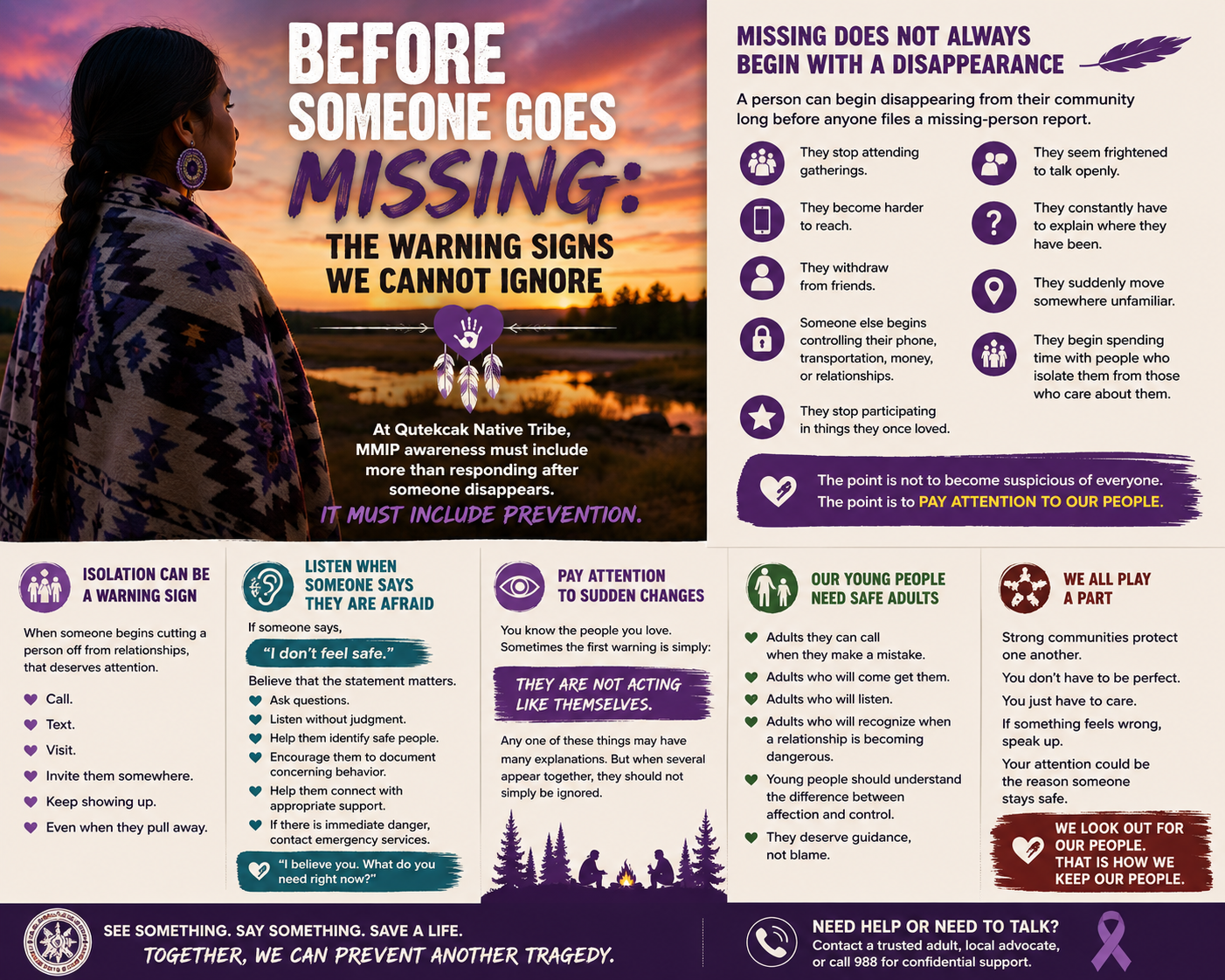
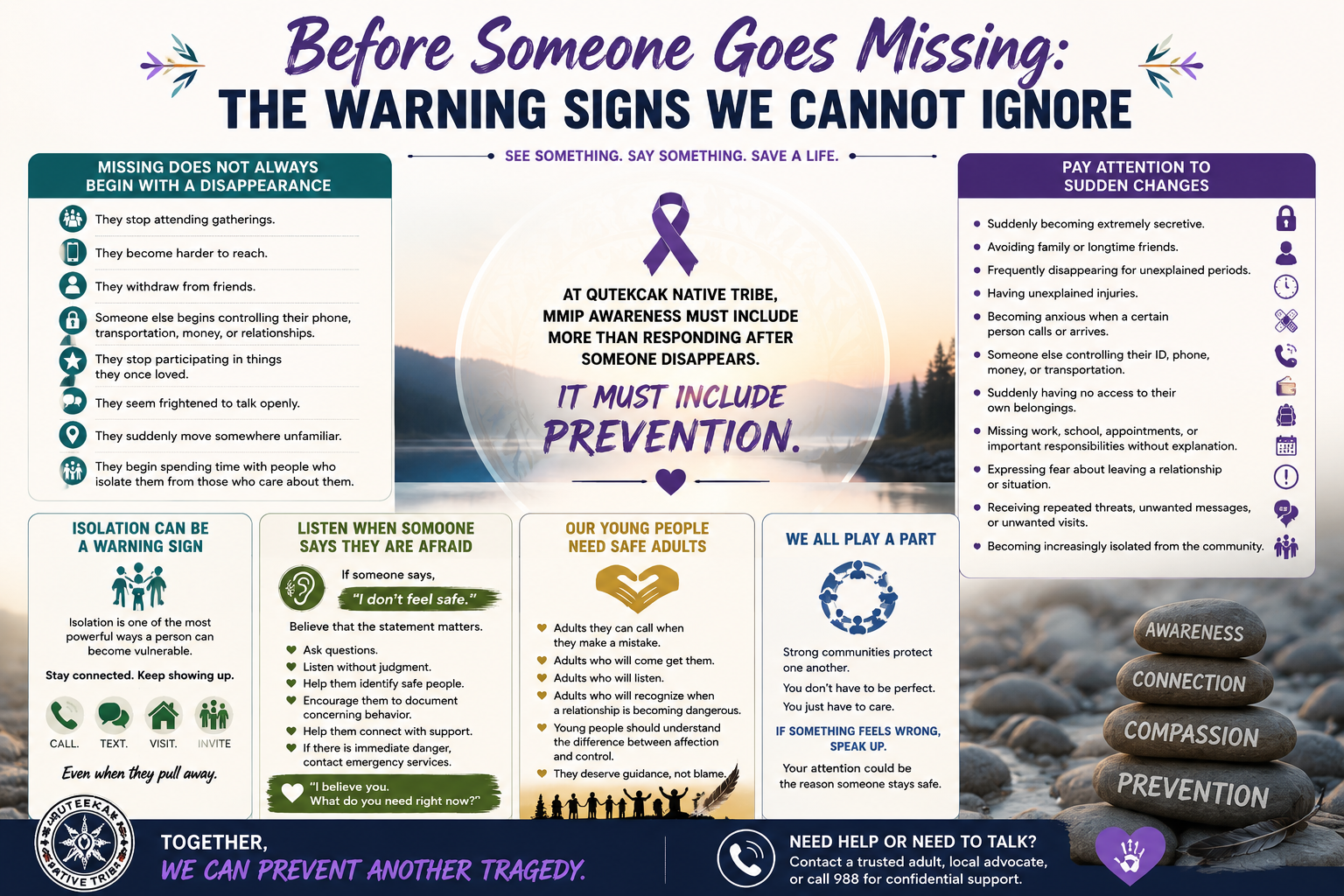
Before Someone Goes Missing:
The Warning Signs We Cannot Ignore
When someone goes missing, the question often comes afterward:
Were there signs?
Sometimes there were.
A relationship that became controlling.
A person who suddenly stopped calling family.
A teenager spending time with people no one knew.
Someone who became isolated.
A friend who started saying they were afraid.
An elder who seemed increasingly vulnerable.
A loved one whose behavior changed so dramatically that everyone knew something was wrong, but no one knew exactly what to do.
Not every warning sign means someone will disappear.
But too often, communities are forced to look backward after a tragedy and wonder whether something could have been done sooner.
At Qutekcak Native Tribe, we believe MMIP awareness must include more than responding after someone disappears.
It must include prevention.
Missing Does Not Always Begin With a Disappearance
A person can begin disappearing from their community long before anyone files a missing-person report.
They stop attending gatherings.
They become harder to reach.
They withdraw from friends.
Someone else begins controlling their phone, transportation, money, or relationships.
They stop participating in things they once loved.
They seem frightened to talk openly.
They constantly have to explain where they have been.
They suddenly move somewhere unfamiliar.
They begin spending time with people who isolate them from those who care about them.
Sometimes these changes have innocent explanations.
Sometimes they do not.
The point is not to become suspicious of everyone.
The point is to pay attention to our people.
Isolation Can Be a Warning Sign
Isolation is one of the most powerful ways a person can become vulnerable.
Healthy relationships allow people to maintain connections with family, friends, culture, community, work, school, and the people they trust.
When someone begins cutting a person off from those relationships, that deserves attention.
A controlling partner may discourage family contact.
An exploiter may convince someone that nobody else understands them.
A trafficker may create distance between a person and everyone who could recognize that something is wrong.
An abusive individual may monitor someone's phone or social media.
Sometimes the person being isolated may not even recognize what is happening.
That is why staying connected matters.
Call.
Text.
Visit.
Invite them somewhere.
Keep showing up.
Even when they pull away.
Listen When Someone Says They Are Afraid
We do not always have to understand someone's fear before taking it seriously.
If someone says:
“I don't feel safe.”
Believe that the statement matters.
If they say someone is following them, threatening them, controlling them, hurting them, or frightening them, do not immediately dismiss it as drama or a relationship problem that will eventually work itself out.
Ask questions.
Listen without judgment.
Help them identify safe people.
Encourage them to document concerning behavior when it is safe to do so.
Help them connect with appropriate support.
And if there is immediate danger, contact emergency services.
One of the most important things a person can hear during a frightening situation is:
“I believe you. What do you need right now?”
Pay Attention to Sudden Changes
You know the people you love.
Sometimes the first warning is simply:
They are not acting like themselves.
Changes worth noticing may include:
Suddenly becoming extremely secretive.
Avoiding family or longtime friends.
Frequently disappearing for unexplained periods.
Having unexplained injuries.
Becoming anxious when a certain person calls or arrives.
Someone else controlling their identification, phone, money, or transportation.
Suddenly having no access to their own belongings.
Missing work, school, appointments, or important family responsibilities without explanation.
Being unable or unwilling to say where they are staying.
Expressing fear about leaving a relationship or situation.
Receiving repeated threats, unwanted messages, or unwanted visits.
Becoming increasingly isolated from the community.
Any one of these things may have many explanations.
But when several appear together, they should not simply be ignored.
Our Young People Need Safe Adults
Prevention begins long before someone is ever considered missing.
Our children and young people need adults they can call when they make a mistake.
They need to know that asking for help will not automatically lead to shame, screaming, punishment, or rejection.
They need adults who will come get them.
Adults who will listen.
Adults who will recognize when a relationship is becoming dangerous.
Young people should understand the difference between affection and control.
Someone constantly demanding a person's location is not automatically love.
Someone demanding passwords is not trust.
Someone deciding who a person may speak to is not protection.
Someone threatening self-harm, violence, exposure, or humiliation to prevent a person from leaving is not a healthy relationship.
Someone offering gifts, rides, housing, money, substances, or opportunities in exchange for control may not be helping.
We have to teach these conversations before our young people find themselves trying to navigate them alone.
Check on the Person Who Suddenly Goes Quiet
Sometimes we assume someone wants space.
Sometimes we tell ourselves they are busy.
Sometimes months pass.
That is why one simple practice can make a difference:
Check on people.
Not only through social media.
Call them.
Stop by when appropriate.
Ask mutual friends whether they have heard from them.
Invite them to community activities.
Check on elders.
Check on people living alone.
Check on relatives who recently left difficult relationships.
Check on the person everyone says is “probably fine.”
Connection creates visibility.
Visibility creates protection.
Do Not Shame People for Returning to Dangerous Situations
Leaving an abusive or exploitative situation is not always simple.
People may return.
They may defend the person hurting them.
They may leave and then go back.
They may stop talking about what is happening.
They may be afraid of losing housing, children, finances, transportation, family relationships, or community connections.
Shaming someone for returning can make them even more isolated.
Instead of saying:
“Why did you go back?”
Try:
“I'm still here.”
The goal is to keep a bridge open.
Because someday that bridge may become the way home.
Know Who Your People Are With
This does not mean policing every person's life.
It means families staying connected.
Know your children's friends.
Know who regularly gives them rides.
Know where elders are going.
Know the names of new people spending significant time around vulnerable relatives.
Keep emergency contacts current.
Have recent photographs.
Know vehicle descriptions when possible.
Talk about travel plans.
Encourage family members to check in.
Create habits where letting someone know you arrived safely is normal.
These are small things.
But small things create stronger networks around people.
Speak Up Before You Have Proof
Sometimes people remain silent because they are afraid of being wrong.
They think:
What if I'm overreacting?
What if it's none of my business?
What if they get angry with me?
There is a difference between spreading accusations and expressing concern.
You can say:
“I have noticed some changes and I want to make sure you're okay.”
You can tell a trusted family member:
“I am worried about them. Have you noticed this too?”
You can ask someone privately:
“Do you feel safe?”
You can document something concerning without posting it publicly.
You can contact the appropriate professionals when a situation appears dangerous.
Concern does not require gossip.
It requires courage.
Prevention Is Community Work
No single person can prevent every tragedy.
No family can control every circumstance.
No Tribe can guarantee that violence will never touch its community.
But we can create conditions that make it harder for people to disappear unnoticed.
We can know our neighbors.
We can watch out for elders.
We can teach our children.
We can support survivors.
We can refuse to normalize controlling relationships.
We can intervene when something feels wrong.
We can make sure people know where to find help.
We can create a community where someone going quiet is noticed.
Because MMIP prevention begins with something incredibly basic:
Knowing that someone is missing because we knew they were there in the first place.
Before There Is a Flyer
Before there is a missing-person poster.
Before there is a case number.
Before there are search parties.
Before a family begins begging the public for information.
There is a person.
Living.
Laughing.
Struggling.
Working.
Parenting.
Learning.
Healing.
Belonging.
And that is where our responsibility begins.
Not after they disappear.
Before.
Qutekcak Native Tribe believes protecting our people means building relationships strong enough to notice when something changes.
Ask the question.
Make the call.
Check on the person.
Listen to the fear.
Keep the door open.
Stay connected.
Because sometimes prevention looks less like a program and more like one person saying:
“I noticed you haven't been yourself. Are you okay?”
And then staying long enough to hear the answer.
Until they all come home, we will keep working to make sure fewer of our people ever go missing in the first place.
Not forgotten. Never invisible. Always our people.