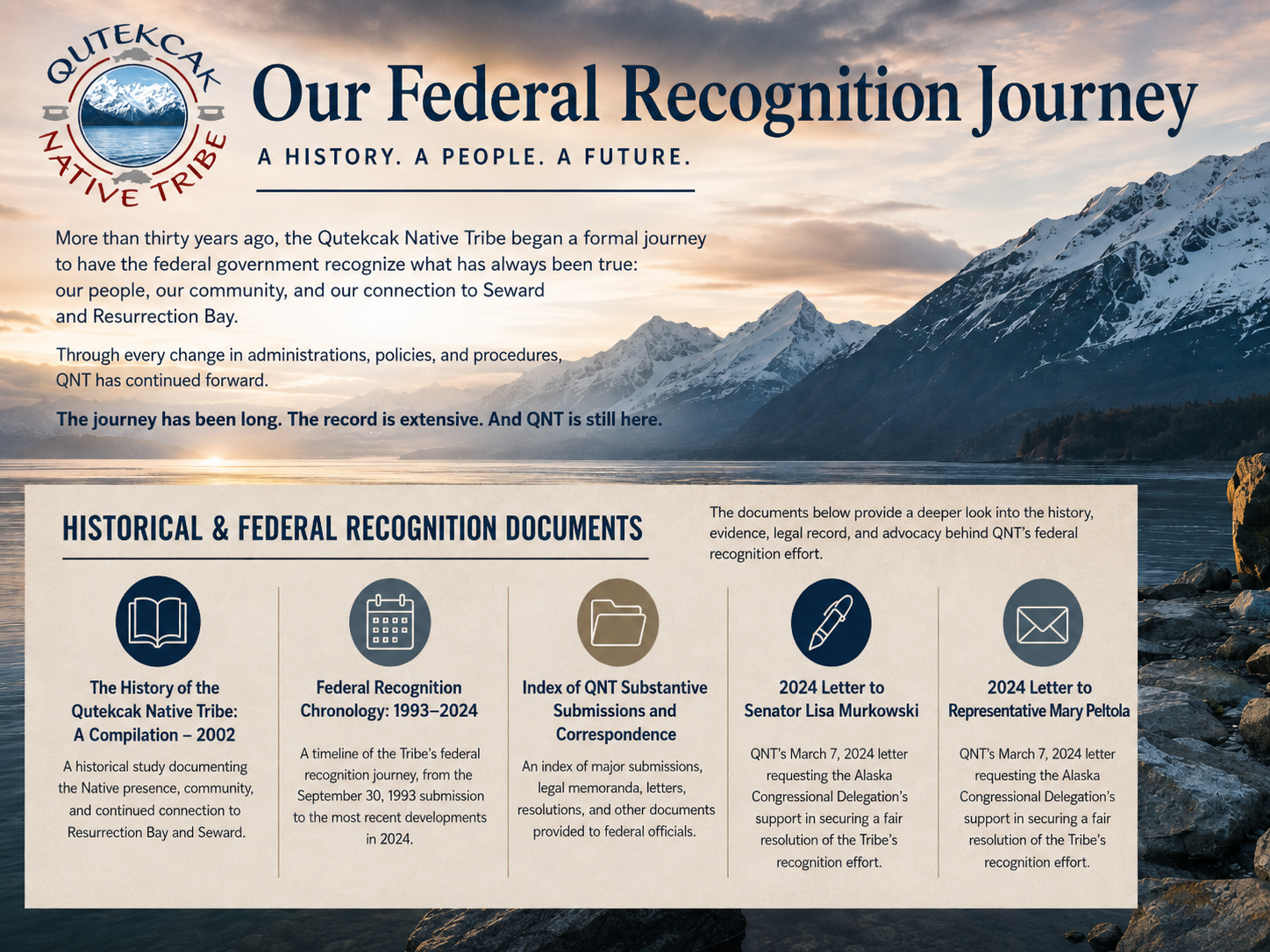
Our Federal Recognition Journey
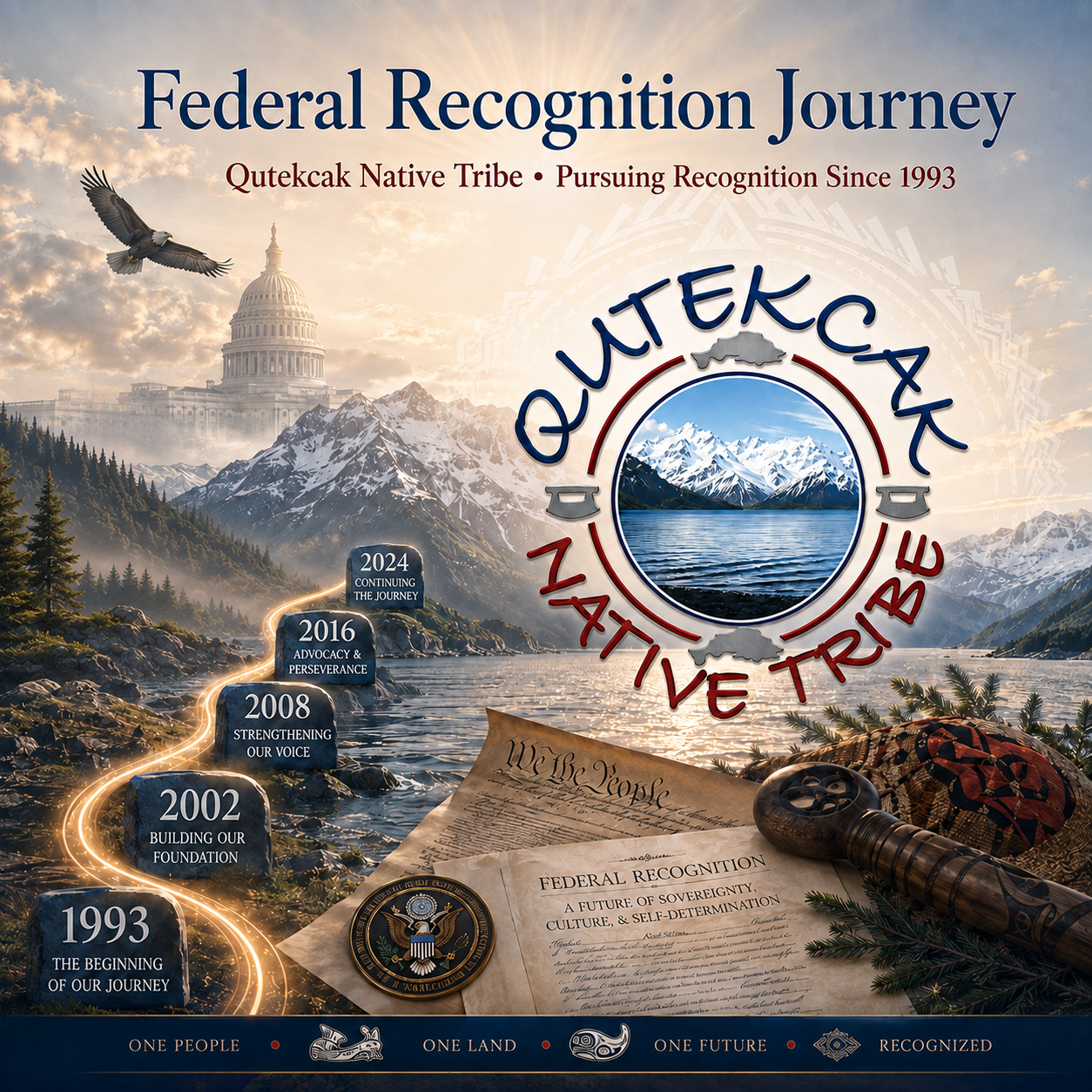
More Than Three Decades of Persistence — and Generations of History Behind It
There are moments in a people’s history that can be marked by a date.
September 30, 1993, is one of those dates for the Qutekcak Native Tribe.
On that day, QNT formally presented its request to organize under the Alaska amendment to the Indian Reorganization Act to the Bureau of Indian Affairs. It began what would become a federal recognition journey spanning more than three decades, multiple presidential administrations, countless meetings, extensive historical research, legal memoranda, congressional inquiries, Tribal resolutions, and repeated engagement with the Department of the Interior.
But September 30, 1993, is not where our story begins.
We Were Here Before the Petition
The history of the Qutekcak people reaches far beyond a federal application.
QNT’s historical research identifies the Unegkunniut, relatives of the Chugach people, as original users and inhabitants of the Resurrection Bay area and as ancestors or forebears of today’s Qutekcak Tribe. The historical record documents Native use and occupancy throughout Resurrection Bay and the surrounding region across generations.
Native families continued living, traveling, hunting, fishing, gathering, working, and building community in and around what became Seward despite extraordinary changes around them.
Russian expansion changed the region.
American settlement changed it again.
Disease devastated Native populations.
Government policies attempted assimilation.
Native children were placed in institutions where English was imposed and cultural identity was often discouraged. Alaska Native people also faced discrimination in voting, land ownership, businesses, restaurants, public facilities, and other parts of daily life.
And still, the community remained.
Families gathered.
Traditions continued.
People hunted and fished together.
They cared for one another.
They maintained relationships that could not be erased simply because those relationships were not always recognized or recorded by outside institutions.
From Community to Formal Organization
By the 1960s, Native leaders from Seward were actively involved in regional Native advocacy and helped form the Chugach Native Association.
In 1972, the Mount Marathon Native Association was formally created. The Tribe’s commissioned history explains that this formal organization documented an Native community that already existed, with continuing ancestral ties, common bonds of association, use, occupancy, and residence.
Mount Marathon Native Association later became the Qutekcak Native Tribe in 1993.
That distinction matters.
QNT was not created by a federal recognition petition.
The petition was an effort to obtain federal acknowledgment of a community, government, and history that already existed.
1993: The Formal Journey Begins
When QNT submitted its request in September 1993, the Tribe sought to organize under the Alaska amendment to the Indian Reorganization Act.
By 1994, QNT was already concerned about delays and sought assistance from Senator Ted Stevens.
The Bureau of Indian Affairs prepared technical comments regarding QNT’s proposed constitution in June 1994. Those comments were not provided to the Tribe until April 1996.
Importantly, those comments did not question QNT’s eligibility to organize. They instead requested further work concerning governing documents and the base roll/eligible voters list.
QNT did what it has done repeatedly throughout this journey.
It responded.
It gathered information.
It followed the guidance it was given.
And it continued.
Submission After Submission
QNT submitted an updated request in 2002 incorporating the BIA’s technical corrections.
That submission was transferred into the Part 83 federal acknowledgment process rather than continuing through the Alaska IRA process QNT had requested.
The Tribe objected and repeatedly asked Interior to return to the Alaska IRA framework.
In 2008, QNT presented another extensive submission.
It included an ethnographic report and support from neighboring Tribes, regional and statewide Tribal organizations, elected officials, and the City of Seward.
Over the years that followed, QNT and its legal counsel submitted legal memoranda, governing documents, historical material, genealogical analysis, membership documentation, briefing papers, and extensive evidence concerning the Seward Alaska Native community.
The record was not built overnight.
It was built document by document, meeting by meeting, administration by administration.
A Decision That Never Came
By September 2015, QNT had been advised that the Solicitor’s Office had prepared draft decision documents for the Assistant Secretary.
Still, no final decision was issued.
In 2016, QNT again worked extensively with federal officials.
According to QNT’s chronology, Deputy Solicitor Jody Cummings agreed in August 2016 to facilitate a decision before the end of the Obama Administration if QNT did not file an unreasonable-delay lawsuit.
Discussions continued.
Briefing materials were submitted.
In December 2016, Interior officials told the Alaska Congressional Delegation that a decision would be issued before the administration ended.
In January 2017, Interior again indicated that it intended to issue a decision.
No decision came.
The Tribe Kept Going
QNT did not stop.
The Tribe continued meeting with Interior officials and members of Alaska’s Congressional Delegation.
The Alaska Federation of Natives supported action on QNT’s request.
QNT participated in federal rulemaking concerning Alaska IRA recognition.
The Tribe submitted formal comments.
In 2021, Congressman Don Young adopted a discussion draft of legislation recognizing QNT.
That same year, QNT again resubmitted recognition materials at the request of federal officials, and Alaska’s Congressional Delegation sent a joint letter supporting the Tribe’s effort.
In June 2022, QNT leadership met with Assistant Secretary–Indian Affairs Bryan Newland during the National Congress of American Indians conference in Anchorage. QNT was informed of Interior’s commitment to case-by-case review of pending Alaska IRA petitions.
Again, QNT asked for timelines.
Again, the Tribe asked for clarity.
Again, it continued forward.
And the Journey Continues
In December 2023, QNT leadership met with Senator Dan Sullivan regarding the Tribe’s petition, new federal guidance, and possible paths forward.
In 2024, QNT again sought assistance from Alaska’s Congressional Delegation.
Support also came from Native organizations and advocates, including the Native American Rights Fund and the National Congress of American Indians.
QNT continued advocating for review under the statutory common-bond standard and submitted additional comments in September 2024.
More than thirty years after the formal process began, the journey was still continuing.
Why We Are Sharing the Record
As part of our commitment to transparency and preservation, QNT is beginning to make important historical and federal recognition documents available to the public through our website.
Among those records is The History of the Qutekcak Native Tribe: A Compilation, commissioned by QNT and completed in March 2002.
The purpose of that work was to more fully document Tribal history and provide educational material about Alaska Native history in the Seward area.
Additional materials document the recognition chronology, major submissions, correspondence, and congressional advocacy that have shaped this effort.
We want future generations to be able to see the record.
Not just the delays.
Not just the letters.
Not just the legal arguments.
But the persistence behind them.
We Are Still Here
Administrations changed.
Federal officials changed.
Policies changed.
Processes changed.
Interpretations changed.
QNT remained.
Our history did not begin when a federal agency opened a file.
Our identity was not created by an application.
Our community did not suddenly appear in 1993.
The federal recognition journey is one chapter in a much longer Qutekcak story.
It is a story of people who maintained connection through enormous change.
It is a story of Elders who remembered.
Leaders who organized.
Families who remained.
Researchers who documented.
Advocates who spoke.
And generations who refused to allow the history of the Seward Native community to disappear.
More than three decades after QNT formally began this process, the record continues to speak.
The history reaches back generations.
The recognition record spans more than three decades.
The journey continues.
And QNT is still here.